

Voice Architecture
Your clinical wisdom is already there. The gap is in the translation.
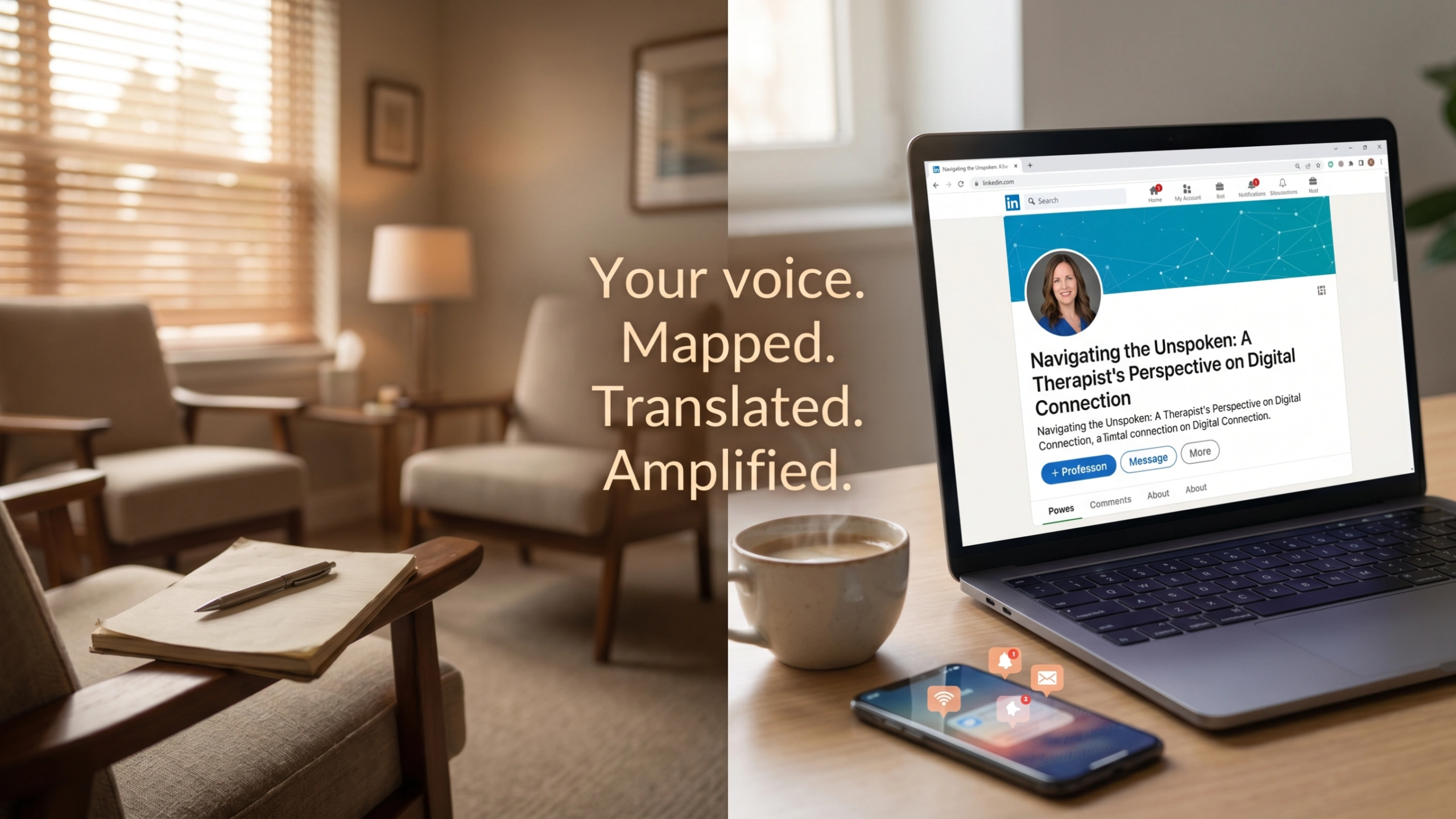
There’s a silence when someone finally says the thing they’ve been carrying alone.
Your team knows things most content agencies will never know. They know the phrase that settles a terrified family in their first intake call. They know the reframe that shifts a client from resistance to readiness. They know what recovery actually looks and sounds like — not in the clinical literature, but in the room.
None of that is in your content.
Your homepage reads like a credentialing document. Your blog sounds like every other center in your market. Your social posts cycle through the same awareness-month graphics. And the person searching for you at midnight—someone who is scared, overwhelmed, and one scroll away from calling somewhere else—reads your copy and keeps scrolling.
That’s the problem Voice Architecture solves.
→ See How Voice Architecture Works (No pitch. No pressure. Just the process.)
Schedule a 20-minute Voice Audit
What Voice Architecture Is
Voice Architecture is a structured extraction and documentation process. It captures the clinical DNA of your organization — the specific language, philosophy, and communication instincts of your clinical team — and converts that intelligence into a repeatable content system that governs everything you publish.
It’s not a content package. It’s not ghostwriting in the conventional sense. It’s not a social media service or a blogging retainer.
Voice Architecture is infrastructure. It’s the foundational layer that makes every subsequent piece of content your organization produces sound unmistakably like you—rather than like the statistical average of your industry.
Voice Architecture is the process of extracting the clinical wisdom locked inside your organization and converting it into a documented language system that reaches the right person at the right moment—before they ever pick up the phone.
The Problem It Solves
The Trust Gap
Most behavioral health organizations have invested years—sometimes decades—in developing exceptional clinical programming. That clinical excellence is real. The problem is that the content published under your brand rarely reflects it.
Most behavioral health content communicates in a dialect built for professional credentialing, not human connection. Credential-forward. Outcome-focused. Jargon-heavy. Structurally indistinguishable from dozens of competing organizations. The website that should function as a first point of human contact reads instead like a discharge summary.
The person searching for you isn’t looking for a brochure. They’re looking for a voice that makes them feel understood before they’ve said a word.
Voice Erosion
Voice Erosion is what happens over time when organizations publish content without a governing voice system. Each piece of generic copy published under your brand name is another layer of distance between the clinical wisdom inside your building and the people searching for it outside.
It’s not always visible in a single post. It accumulates. And by the time most organizations notice — when the clinical director is quietly frustrated that the website “doesn’t sound like us” — the gap is wide.
The Mission Problem
This isn’t just a marketing issue. When your content fails to reflect your clinical philosophy accurately, you’re not just losing admissions. You’re failing the person who Googled at midnight and didn’t find the voice that could have reached them—and kept scrolling to a center with inferior programming and better language.
That miss has a clinical outcome. It belongs to the mission of the organization trained for years to prevent exactly that kind of gap.
The Voice Architecture Process
Voice Architecture is a four-phase process that precedes any content creation. It is designed to extract the clinical intelligence that no AI model can access without specific, guided input: the philosophical frameworks behind your programming, the specific language your clinical team uses and deliberately avoids, the population-specific insights developed through hundreds of intakes, and the communication instincts that emerge when your staff is genuinely connecting with someone in crisis.
Phase 1: Contextual Intake
Before a single question is asked, a full audit of your existing content ecosystem is conducted.
That includes your homepage, primary service pages, current blog content, social media presence, any existing brand voice or style guide documentation, and a read of 3–5 direct competitors.
The audit identifies your specific trust gaps, your voice erosion patterns, and the language mismatches between what your clinical team says in the room and what your published content says online. It also surfaces what’s already working — the authentic language fragments worth preserving and amplifying in the architecture.
Phase 2: Structured Asynchronous Interviews
The core of Voice Architecture is a set of structured written interview prompts delivered to key voices inside your organization—typically the clinical director, executive director, and one or two senior clinical staff members whose language is most representative of your approach.
The interview questions are designed to surface the clinical DNA of your organization. Not the polished, PR-ready version of your story — the authentic philosophical and linguistic patterns that emerge when clinical leaders are thinking out loud rather than performing for an audience.
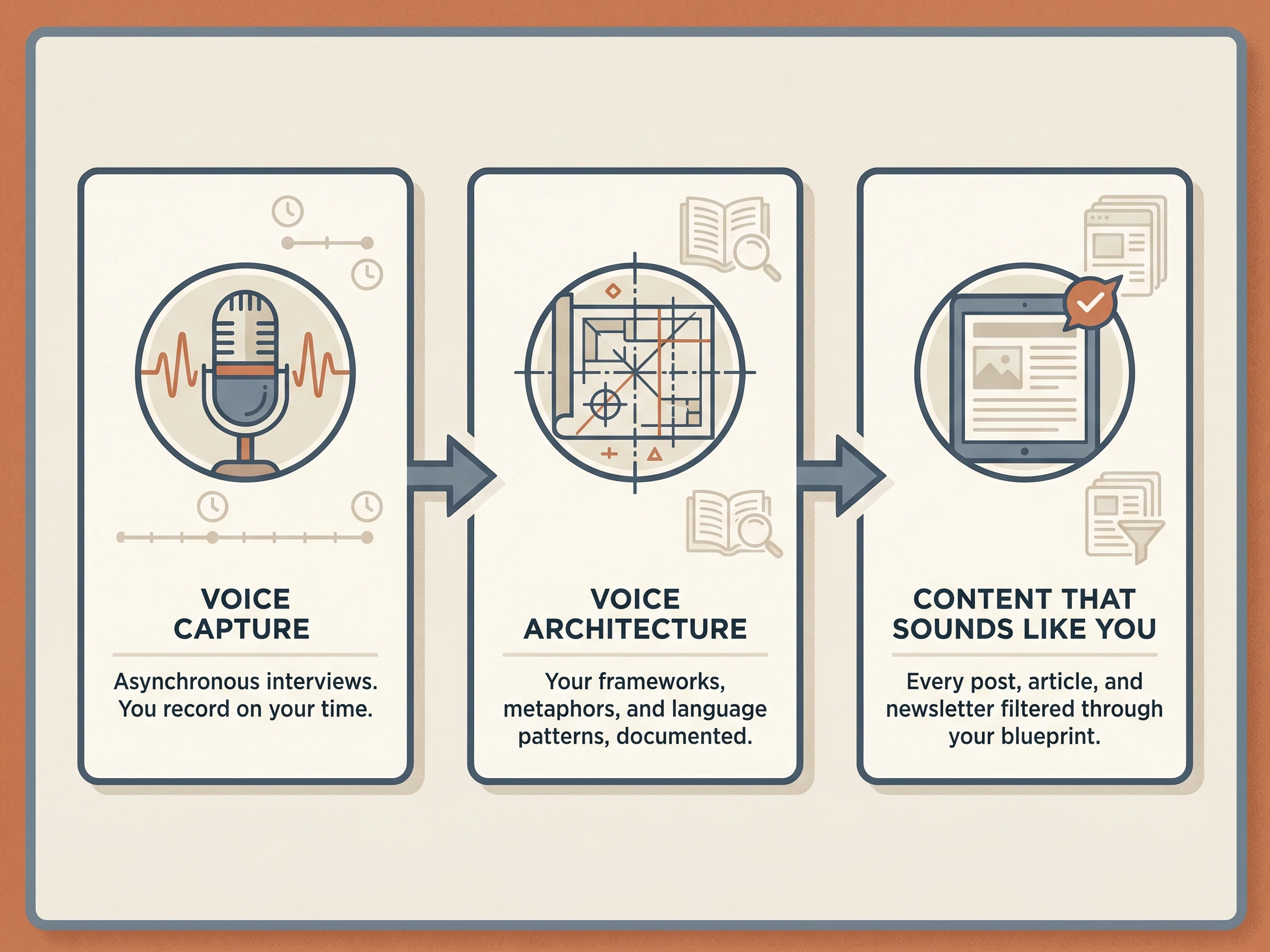
The process is asynchronous by design. Live discovery calls create pressure to perform coherently in real time. That pressure gets in the way of thinking clearly. Structured pre-recorded interview questions. Participants record their responses on their own time when they are at their best, producing richer, more authentic material than any live interview format.
Representative questions include:
-
Tell me about the case that changed how you understand recovery. Not the outcome — the moment your understanding shifted.
-
What do families consistently misunderstand about the work you do?
-
What words or phrases do you use in intake conversations that you’ve never seen in your published content?
-
What fear do most of your incoming clients share that rarely, if ever, appears in your published content?
-
What does your center’s content currently fail to communicate about your clinical team?
Phase 3: Voice Architecture Document Construction
From the interviews, the intake audit, and the contextual analysis, the Voice Architecture Document is constructed. This is the foundational deliverable — the translation manual that governs all subsequent content.
The document contains:
Voice Identity Summary — A concise articulation of your clinical voice: its tone, register, philosophical stance, and the emotional experience it’s designed to create in a reader. The north star every content decision is measured against.
Language Architecture — Your preferred vocabulary, avoided vocabulary, signature phrases, and translation pairs that map clinical terminology to plain human language.
Example translation pair:
Clinical: “Evidence-based cognitive behavioral intervention.”
Voice Architecture: “Tools that help you recognize the patterns keeping you stuck.”
Philosophical Framework — Your core clinical beliefs in plain language. The reframes your team uses when clients express common fears. How your organization thinks about recovery in terms that are both accurate and human.
Audience Language Maps — How you speak to families in crisis. How you speak to referral sources. How you speak to the person in crisis themselves. Language calibrations for different stages of the decision journey — from the midnight search to the intake call to the clinical relationship.
Trust Gap Diagnostics — Specific identification of current trust gaps in your content, with before/after language examples showing exactly what the gap is costing you.
Content Architecture Guidelines — Structural templates for key content types: homepage copy, blog posts, social content, email sequences. Formatting and rhythm guidance that reflects how your clinical voice sounds in written form.
Ownership: The Voice Architecture Document belongs to your organization permanently. It doesn’t expire. It doesn’t require ongoing payment to maintain. Any writer, internal team member, or AI tool your organization works with in the future can use it to produce on-voice content—indefinitely.
Phase 4: Content Deployment
With the Voice Architecture Document in place, content deployment begins. Every piece of content—blog posts, LinkedIn thought leadership, newsletters, website copy, email sequences, video scripts, social captions—is filtered through the Voice Architecture Document before publication.
This is what makes Voice Architecture an infrastructure build, not a service. The document doesn’t require monthly renewal. It becomes the permanent translation layer between the clinical wisdom inside your organization and the content that represents it in the world
The Digital Therapeutic Voice
After analyzing more than 100 mental health websites, one pattern became clear: the homepages that feel like sanctuary follow a specific linguistic sequence. The ones that read like sterile waiting rooms follow a different one.
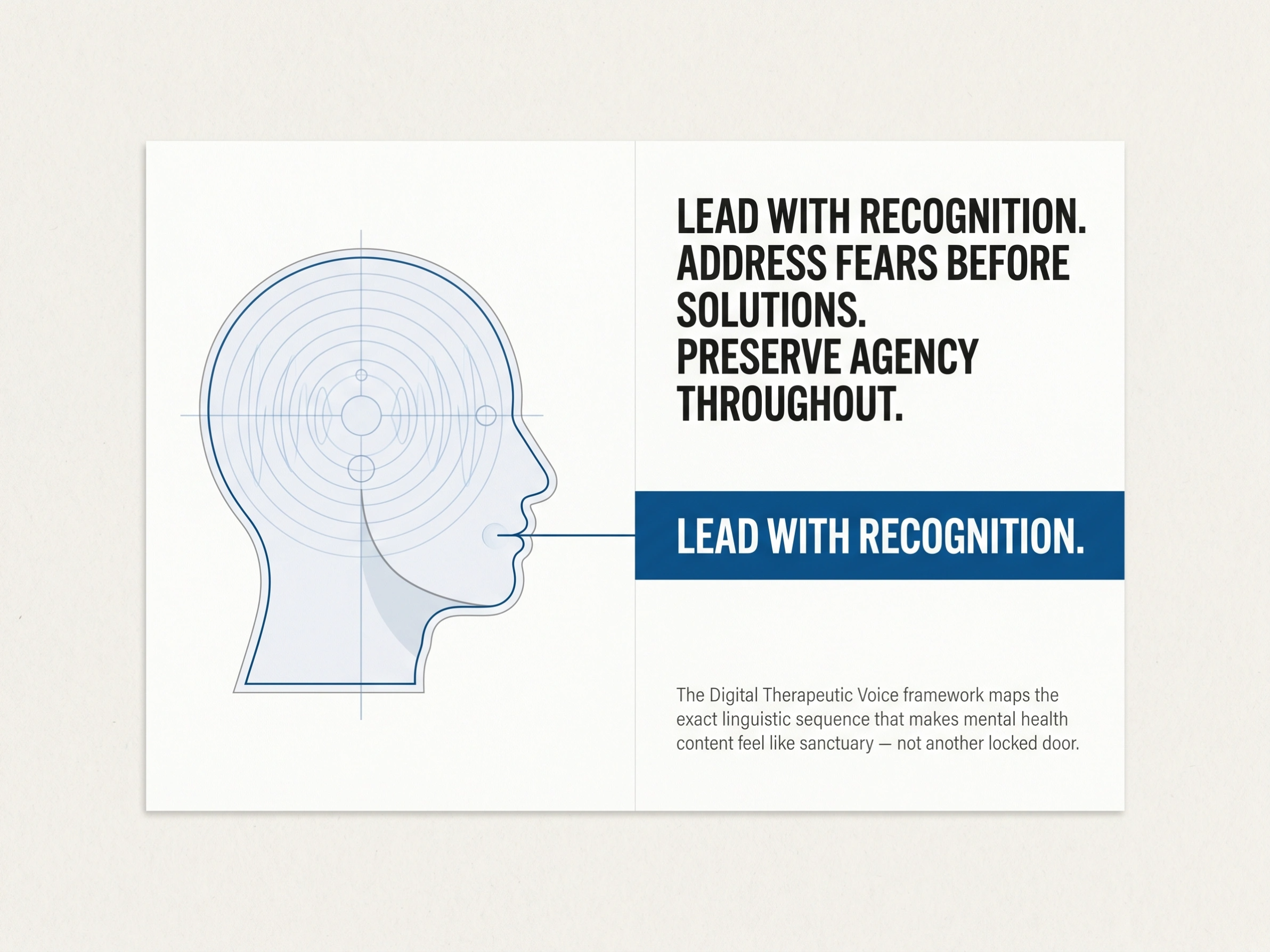
The Digital Therapeutic Voice (TDTV) is the framework built from that analysis. It guides every piece of content produced through this process—mental health blog writing, social posts, intake page copy, newsletters, video scripts. The sequence:
- Empathy before credentials. People don’t read your bio first. They feel the page first.
- Safety before outcomes. Address the fear of judgment before describing the benefit.
- Agency throughout. Language that invites. Never language that corners.
Get the sequence wrong, and you’re just another locked door at midnight. Get it right, and your content becomes the reason someone picks up the phone.
What You Receive
Primary Deliverable: The Voice Architecture Document
A proprietary, organization-specific translation manual (15–30 pages). Owned by your organization. Governs all future content regardless of who produces it.
Additional deliverables depending on engagement scope:
-
Homepage rewrite — the highest-stakes trust document your organization publishes; typically the first asset rebuilt from the new architecture
-
Flagship content package — the first 3–5 pieces produced under your Voice Architecture, demonstrating what the documented voice sounds like in deployment
-
LinkedIn thought leadership series — posts written in the clinical director’s or executive director’s voice
-
Email sequence — an educational or nurture sequence built from the Voice Architecture to build pre-call trust with prospective families or referral sources
-
Intake language guide — a companion document that aligns your intake communication with your published voice
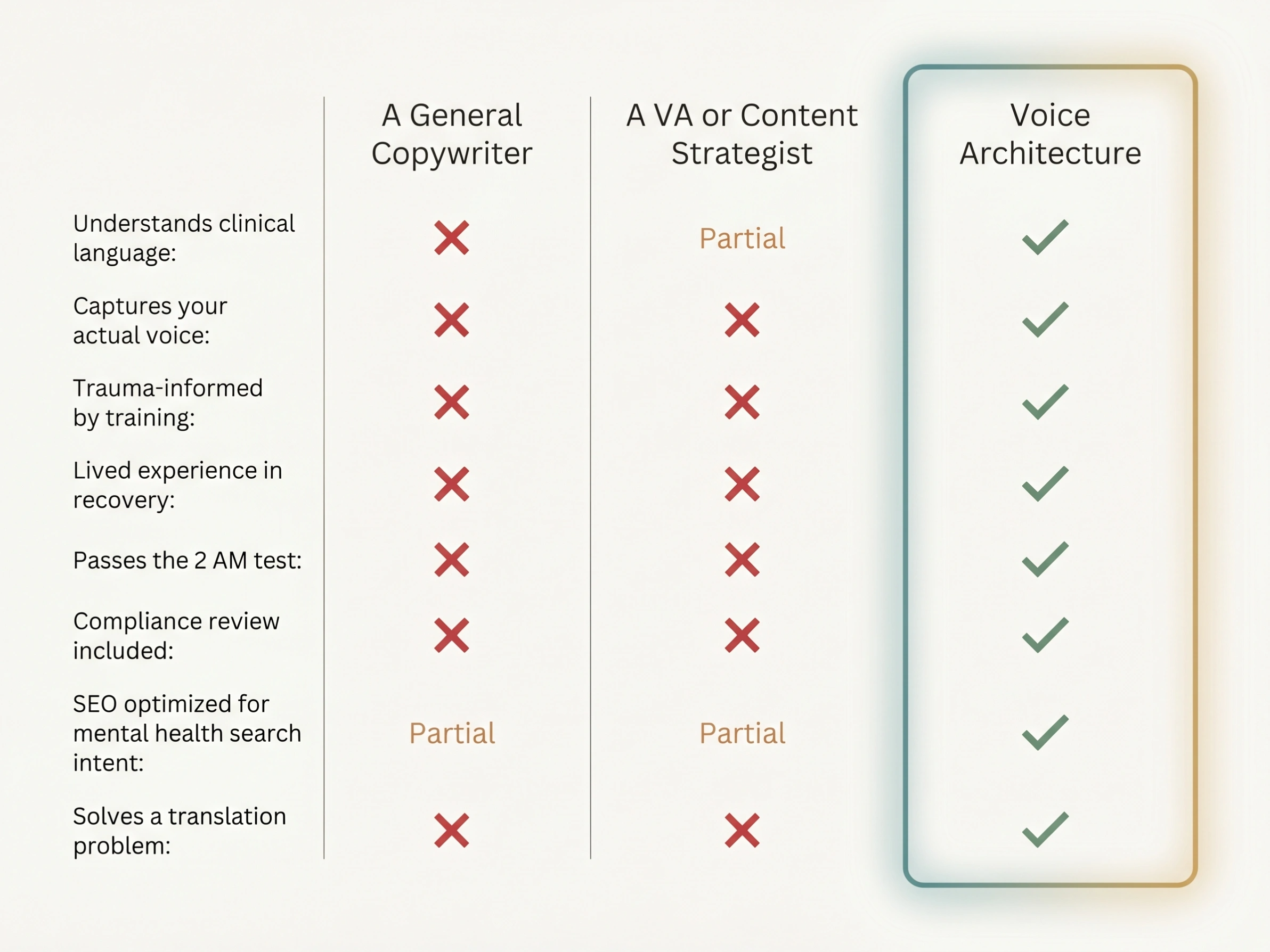
Why It Works Differently
Generic content depreciates. A blog post produced by AI today is barely distinguishable from the one a competitor publishes tomorrow. The competitive field levels continuously.
Voice-driven content compounds. Each piece published under a documented Voice Architecture adds another layer of specificity, authority, and recognition. The family who finds your third article has now encountered your voice three times. By the time they call, they feel like they already know who they’re talking to. The intake conversation is shorter. The relationship is already forming.
Voice Architecture is a fixed, one-time infrastructure investment that makes every subsequent piece of content more effective. Unlike monthly content retainers that produce ongoing inventory without a governing system, Voice Architecture builds the foundation once—and every content investment made afterward operates on top of it.
For most behavioral health organizations, a single additional admission per month, generated by content that converts the families most aligned with your approach, typically covers the investment in Voice Architecture within the first quarter of deployment.

Who This Is For
Mental health and addiction treatment centers—residential, IOP, PHP, outpatient, or detox programs publishing content regularly but struggling to differentiate from competitors, convert website visitors, or produce content that reflects the actual quality of your clinical programming.
Private practice therapists—licensed clinicians (LCSW, LPC, LMFT, PhD, PsyD) who want a digital presence that reflects their clinical identity and attracts aligned clients.
Behavioral health CMOs and marketing leaders—Senior marketing professionals who need a documented content system that can survive staff turnover, align clinical and marketing teams, and produce consistent brand voice across all channels.
Clinical directors as thought leaders—Individual clinical leaders who want to establish a public voice that reflects their expertise and attracts referral relationships, speaking opportunities, or aligned organizational partnerships.
Start With the Voice Audit
The Voice Audit is a 20-minute diagnostic conversation. It’s where Voice Architecture begins for every new client.
It’s not a sales call. It’s not a pitch presentation. It’s a genuine diagnostic conversation.
In 20 minutes:
-
Your current homepage and primary content are reviewed
-
The specific places where generic language is replacing your clinical voice are identified
-
The trust gaps are named—the moments where a family searching late at night would scroll past rather than stay
-
You see what your content could communicate if the architecture were in place
You leave with a clear diagnostic picture of what your content is currently saying and what it could say—regardless of whether you move forward with a full Voice Architecture engagement.
The value of clarity stands on its own.
Not sure which fits? Start with a conversation, not a commitment.
→ Tell Me Where You’re At
(I’ll tell you which one fits—or whether either does.)

Why Antonio Matta Can Write This
I trained as a journalist. Radio broadcasting. Communications at the State University of New York. Then, peer support specialist certification, person-centered counseling training, complementary psychotherapy, PAIRS Essentials training, and Yale’s emotional intelligence program.
I’ve also lived what many of my clients treat. Neurodivergent. C-PTSD diagnosis. A period of homelessness in New York City. Years learning that survival and healing aren’t the same thing—and that both require language most people don’t have access to yet.
I didn’t approach mental health from the outside and work my way toward understanding. I started inside and worked my way toward language that could hold it.
Seven books on mental health recovery, trauma, and identity. A thriving podcast — Recovery Dialogues & Sober Stories. And seven-plus years of ghostwriting for therapists, clinical directors, treatment centers, and nonprofits who do exceptional work but struggle to make people believe it from a screen.
I founded Content Done Write because I believe one thing: your clinical wisdom shouldn’t stay trapped in therapy rooms. It belongs to the families searching at 3 AM. The policymakers who need clinical voices. The practitioners who are struggling with exactly what you’ve learned to navigate.
This work is translation. And I’ve spent my whole life getting fluent.
Your Expertise Deserves a Voice That Reaches
Someone right now is typing your specialty into Google. They’re scared. They’re skeptical. They’ve read twelve websites that all sound like each other.
Your content can be the one that sounds different — because it actually is.
→ Start the Conversation
No obligation. No hard sell. Just clarity on whether this is the right fit.
Our Done Right Promise
All content creation is work-for-hire. We promise to deliver our best. Our high-quality content will match your vision in the brief. Integrity and a commitment to ethics guide us. Our goal is not only to meet but also to exceed your expectations whenever possible. To ensure your satisfaction, we allow up to two free revisions (based on the scope of the changes).
Our Service Commitment to High-Quality Content Creation
Regardless of the content’s intended purpose, Content Done Write will try to employ specific optimization tools and resources whenever possible, not limited to the following purposes:
-
- SEO content grading
- Semantic analysis
- Contextual DNA
- Search intent
- Popular industry-related interests
Research-dependent content will be sourced from academic and peer-reviewed journals, government databases, public records, and any other relative and credible resources made available to Content Done Write through professional memberships and affiliations with exclusive permissions, rights, and access not limited to:
- The Journal of the American Medical Association (JAMA)
- The American Journal of Public Health
- Wiley Online Library
- Annual Reviews
- Health Affairs
- Academia
- ResearchGate and others